Beginner first aid training

Basic First Aid
Online Theory & Practical Skills

Build the knowledge and confidence to respond safely and effectively when someone is injured or suddenly becomes ill. Learn a clear first-aid response process, then complete the practical component after your online theory.

Explore More Courses

Online theory • Practical component arranged after online completion • 3h 30m online duration • Beginner level

Basic First Aid online course from OHS All 4 Skills
R1150 sale priceR900
R900Current fee
3h 30mOnline theory
BeginnerCourse level
9Learning modules
Theory + PracticalCourse format
First aid readiness

Know what to do when the first few minutes matter

This beginner-friendly course develops the essential knowledge required to respond to common emergencies in a calm, safe and structured way. It introduces the responsibilities of a first aider, personal and scene safety, patient assessment, life-saving interventions and the management of common injuries and illnesses.

  • Understand the role, responsibilities and limits of a first aider.
  • Assess an emergency scene and protect yourself, the casualty and bystanders.
  • Apply primary assessment principles, including airway, breathing and circulation.
  • Learn the principles of CPR and Automated External Defibrillator (AED) use.
  • Recognise and respond to common injuries, illnesses and environmental emergencies.
  • Communicate clearly with emergency services and provide an organised patient handover.
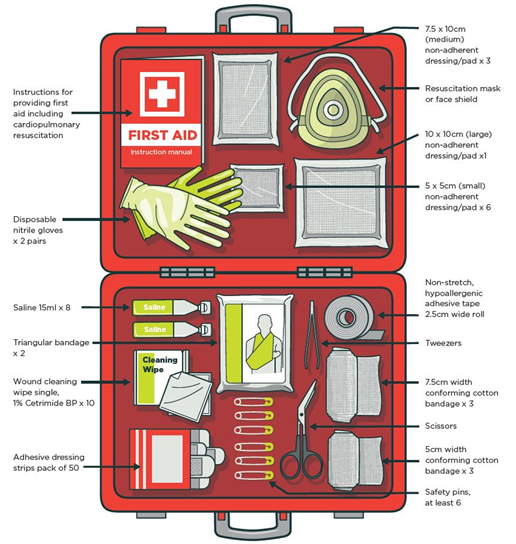
Basic first aid kit learning material
What you will learn

Practical first aid knowledge for real emergencies

The learning pathway starts with safe first-aid practice and basic body systems, then moves into scene management, casualty assessment, resuscitation and a wide range of common emergency situations.

01

Assess safely

Recognise scene hazards, use protective measures and manage an emergency without creating additional casualties.
02

Assess the casualty

Use a structured primary survey, monitor responsiveness and understand the purpose of vital-sign observations.

03

Support life

Learn the principles of CPR, recovery positioning and AED use for life-threatening emergencies.

04

Manage common emergencies

Build first-aid knowledge for bleeding, burns, fractures, choking, shock, poisoning, allergic reactions and environmental emergencies.

Who should enrol?

Ideal for everyday and workplace readiness

The course is designed for beginners and for people who want the confidence to provide immediate assistance while professional medical help is on the way.

Employees Workplace teams Caregivers Parents & guardians Community members First-time learners
Course format

Online learning followed by practical completion

  • Beginner-level online theory with a Tutor LMS duration of approximately 3 hours 30 minutes.
  • 9 instructional modules covering 38 lesson pages in the core learning sequence.
  • Course theory test included in the learning structure.
  • Practical component arranged after successful completion of the online course.
  • Student handbook and course resources are included in the Tutor LMS course information.
  • Certificate system is configured for the course in Tutor LMS.
Course InformationCourse information
  • Important Student Course Information
Module 1: Introduction to First Aid4 lessons
  • Lesson 1: Understand the role and responsibilities of a first aider
  • Lesson 2: Learn the legal and ethical considerations of first aid
  • Lesson 3: Understand personal safety measures and infection control
  • Lesson 4: Familiarize with the contents of a basic first aid kit
Module 2: Overview of Human Anatomy and Physiology6 lessons
  • Lesson 1: Overview of the essential components of the human anatomy and physiology
  • Lesson 2: Fundamentals of the respiratory system
  • Lesson 3: Fundamentals of the Cardiovascular System
  • Lesson 4: Fundamentals of the Nervous System
  • Lesson 5: Fundamentals of the Musculoskeletal System
  • Lesson 6: Fundamentals of the Integumentary System
Module 3: Emergency Scene Management4 lessons
  • Lesson 1: Learning How to Assess an Emergency Scene for Safety
  • Lesson 2: Reassessment of Vital Signs
  • Lesson 3: Post-Scene Decontamination and Cleanup
  • Lesson 4: Understanding How to Effectively Communicate with Emergency Services and Bystanders
Module 4: Primary Patient Assessment (ABCs)5 lessons
  • Lesson 1: The Primary Survey
  • Lesson 2: Measuring and Recording Vital Signs
  • Lesson 3: Recording Vital Signs
  • Lesson 4: Recovery Position: How to place an unconscious person in the recovery position
  • Lesson 5: Understanding the ABCs of First Aid: Airway, Breathing, and Circulation
Module 5: Cardiopulmonary Resuscitation (CPR) and AED Use2 lessons
  • Lesson 1: CPR Techniques: Adult, child, and infant CPR (chest compressions, rescue breaths)
  • Lesson 2: AED Use: When and how to use an AED
Module 6: Common Medical Emergencies9 lessons
  • Lesson 1: Managing Bleeding: Direct pressure, elevation, and tourniquet use
  • Lesson 2: Burn Treatment: Cooling burns, severity classification, and dressing
  • Lesson 3: Fractures: How to immobilize a limb with splints
  • Lesson 4: Choking: Heimlich manoeuvre for adults, children, and back blows and chest thrusts for infants
  • Lesson 6: Secondary Assessment & Vital Signs
  • Lesson 7: Shock Management
  • Lesson 8: Sprains and Strains
  • Lesson 9: Heart Attack and Stroke
  • Lesson 10: Poisoning: First aid for poisoning, including ingestion, inhalation, and skin contact
Module 7: Respiratory and Allergic Emergencies2 lessons
  • Lesson 1: Asthma Attacks: Using inhalers, recognizing symptoms, assisting with breathing
  • Lesson 2: Severe Allergic Reactions (Anaphylaxis): Using an EpiPen for treatment
Module 8: First Aid for Environmental and Poisoning Emergencies4 lessons
  • Lesson 1: Heatstroke Symptoms and first aid treatment
  • Lesson 2: Hypothermia Symptoms and first aid treatment
  • Lesson 3: Bites, Stings
  • Lesson 4: Chemical Exposure
Module 9: Transporting and Handover to EMS2 lessons
  • Lesson 1: Safe Transport Techniques: When and how to move an injured person
  • Lesson 2: Handover to Emergency Services: Providing an effective handover of patient details to EMS
Course Theory TestTheory test
  • Course Theory Test
How the course works

Learn online. Build practical readiness.

The course combines accessible online theory with a practical component so learners can first understand the principles and then complete the required hands-on element.

1

Complete the theory

Work through the online learning sequence in Tutor LMS and complete the course theory requirements.

2

Arrange the practical

After successful online completion, arrangements are made for the practical component of the course.

3

Apply the skills

Bring the learning together through practical first-aid application and emergency-response readiness.

Complete the course

Finish the required components and use the knowledge within your training level, workplace procedures and emergency arrangements.

Safe first aid practice

Immediate assistance until professional help takes over

First aid is about responding early, protecting life, preventing further harm and supporting the casualty until qualified emergency or medical personnel can take over.

Important course note: This course provides first-aid learning and practical readiness. It does not replace professional emergency medical care. Learners should act within their level of training, follow current workplace procedures and applicable requirements, and obtain emergency medical assistance when required.
Be prepared to respond

Enrol in Basic First Aid for R900

Complete the online theory, build a structured understanding of first aid and then proceed to the practical component arranged after your online completion.

Frequently asked questions

Basic First Aid course information

Who is this course designed for?
The course is designed for beginners, individuals, employees, caregivers and anyone who wants practical first-aid knowledge for emergency readiness.
Is the course fully online?
The theoretical component is completed online. After successful completion of the online course, arrangements are made for the practical component.
How long is the online component?
Tutor LMS lists the online course duration as approximately 3 hours and 30 minutes.
What does the course cover?
The curriculum includes first-aider responsibilities, safety and infection control, basic anatomy and physiology, emergency scene management, primary assessment, vital signs, the recovery position, CPR, AED use, common injuries and illnesses, respiratory and allergic emergencies, environmental emergencies, safe movement and handover to emergency services.
What is the course fee?
The Tutor LMS export lists the standard price as R1150 and the current sale price as R900.
Does the course replace professional emergency medical care?
No. First aid provides immediate assistance and stabilisation until qualified emergency or medical help takes over. Learners should act within their level of training and relevant workplace or emergency procedures.